


LCL vs. FCL: When Should You Choose Consolidation for Your International Shipments?
International shipping involves more than simply moving cargo from one country to another. Businesses need to consider shipment volume, cost, transit time, cargo type, destination requirements, customs procedures & the reliability of their logistics partner. One of the most important decisions is choosing between LCL (Less than Container Load) and FCL (Full Container Load) shipping.
For businesses that do not have enough cargo to fill an entire container, consolidation services can provide a practical & cost-effective solution. Instead of paying for an entire ocean container, multiple shipments from different customers are consolidated into one container & transported together.
But when should you choose consolidation services over FCL shipping? Understanding the differences between LCL and FCL can help businesses make smarter decisions across their international supply chain management operations.
What Is LCL Shipping?
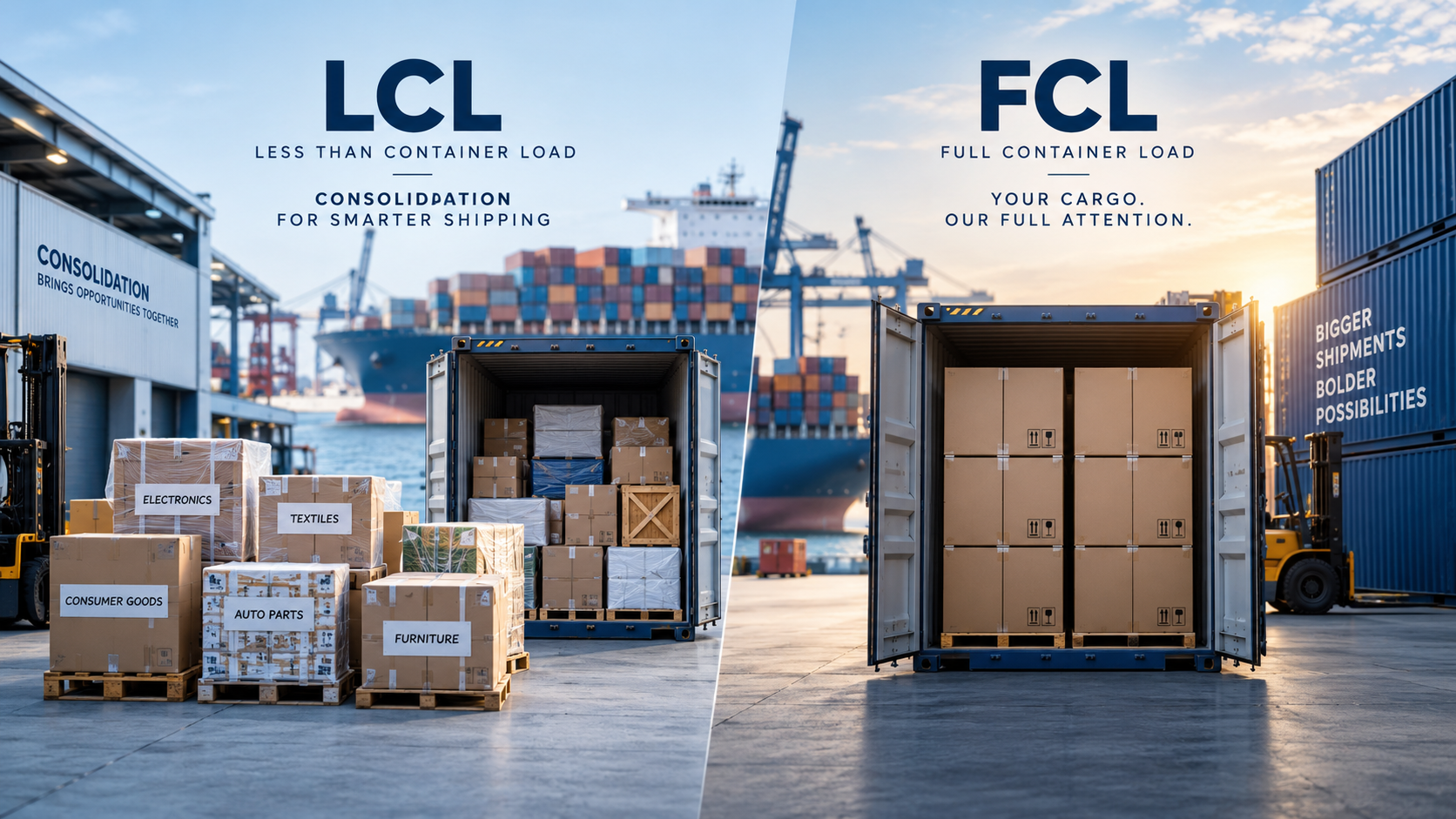
LCL (Less than Container Load) is an ocean freight shipping option used when a shipment does not occupy an entire container. Your cargo is combined with shipments belonging to other businesses, allowing the overall transportation cost to be shared.
This process is commonly referred to as cargo consolidation services. A freight forwarder collects individual shipments, moves them to a consolidation facility then combines compatible cargo into an ocean container & arranges transportation to the destination.
For small and medium-sized businesses, consolidation services can make international shipping more accessible because they eliminate the need to book & pay for a full container when the cargo volume is relatively small.
LCL is particularly useful for small-volume imports and exports, regular shipments that do not justify a full container, businesses testing a new international market, e-commerce & retail shipments & samples, spare parts & smaller commercial consignments.
With the right ocean freight forwarders, LCL can become an efficient part of your broader ocean freight logistics strategy.
What Is FCL Shipping?
FCL (Full Container Load) means one shipper uses an entire container for its cargo. The container may be 20-foot, 40-foot or another suitable configuration depending on the shipment requirements.
Unlike LCL, FCL does not involve sharing container space with other consignments. This can simplify handling and reduce the number of times cargo is moved during transportation.
FCL is generally suitable when your shipment volume is large enough to fill most or all of a container, cargo is fragile or requires dedicated handling, you want greater control over the container, faster transit is important or you have regular high-volume international shipments.
For larger importers and exporters, FCL can be an important component of global logistics solutions, particularly when integrated with warehousing logistics, customs clearance, inland transportation & last-mile delivery.
LCL vs. FCL: What Is the Difference?
The key difference is simple: LCL shares container space, while FCL provides dedicated container space. However, the right choice depends on much more than shipment size. With LCL, container space is shared with other shipments. It is generally better suited to smaller consignments & you pay based on the space or volume your cargo occupies. With FCL, the container is dedicated to your shipment, making it more suitable for larger cargo volumes. LCL can provide greater flexibility for businesses shipping smaller quantities, while FCL can be more efficient for businesses with consistent or high-volume requirements.
When Should You Choose Consolidation Services?
1. When Your Cargo Does Not Fill a Container:
The most obvious reason to choose LCL consolidation is insufficient cargo volume. Suppose you need to ship 5 CBM of commercial goods internationally. Booking a full container may leave significant unused space. With consolidation services, your cargo can share an ocean container with other shipments. Instead of paying for unused container capacity, you pay for the portion of space your shipment occupies. This makes LCL an attractive option for businesses managing smaller shipments through international shipping services.
2. When You Want to Reduce Upfront Shipping Costs:
FCL involves paying for an entire container regardless of whether it is completely utilized. For businesses shipping smaller quantities, this can increase transportation costs. Consolidation allows multiple shippers to share container costs. A reliable freight forwarding company in India can arrange the collection, consolidation, documentation, ocean transportation, deconsolidation & delivery of the shipment. For businesses operating from major commercial hubs, experienced freight forwarders in Mumbai can also coordinate origin-side activities and connect shipments to global destinations.
3. When You Ship Smaller Quantities Frequently:
Not every business has enough cargo to fill a container every week or month. Waiting until sufficient inventory accumulates can delay customer orders and disrupt supply chain logistics. LCL consolidation services allow businesses to ship smaller quantities according to demand rather than waiting to fill an entire container. This can be particularly valuable for companies managing inventory across an international supply chain.
4. When Entering a New International Market:
Businesses expanding into new markets often prefer to test demand before committing to large inventory volumes. For example, an Indian manufacturer entering the USA market may initially ship smaller quantities. USA shipping through LCL consolidation can allow the company to test products, evaluate customer demand, and refine its distribution model without immediately committing to FCL volumes. As volumes increase, the business can transition from LCL to FCL.
When Is FCL the Better Choice?
Although consolidation services are highly useful, LCL is not always the best option. If your shipment volume is large enough to occupy most of a container, FCL may offer better economics. Dedicated containers can also reduce cargo handling because your goods generally remain within the same container throughout the main ocean transportation process. FCL can be particularly beneficial for high-volume manufacturers, distributors, retailers, and businesses with predictable international demand. For companies operating regular USA Trade lane container shipping, for example, FCL may become more efficient once shipment volumes reach a consistent level. FCL may also be preferable for cargo that is highly fragile, sensitive, valuable, or difficult to consolidate with other shipments.
How Consolidation Services Work?
A typical LCL shipment passes through several stages. First, the cargo is collected from the supplier or exporter. It then moves to a consolidation warehouse, where it is measured, documented, checked & combined with compatible shipments. The consolidated cargo is loaded into an ocean container and transported to the destination port. At the destination, the container is moved to a deconsolidation facility, where individual consignments are separated and prepared for delivery. From there, the shipment can move through customs clearance and inland transportation to its final destination. A professional logistics provider can coordinate the entire process through door to door cargo services, covering everything from first mile to last mile delivery.
The Role of Freight Forwarders in LCL Consolidation Services:
Choosing the right logistics partner is crucial when using consolidation services. A professional freight forwarding company manages multiple parties involved in the shipment, including carriers, warehouses, customs agents, transport providers & destination partners. A capable freight forwarding company in Mumbai or freight forwarding company in India can provide the freight forwarding services India businesses need for both imports and exports. These services can include ocean freight & sea freight booking, LCL consolidation & FCL shipping, documentation, customs clearance in Mumbai & other locations, warehousing logistics, inland transportation, ocean freight tracking, cargo insurance coordination, multimodal transport & final-mile delivery. The ability to combine multiple services under one provider can simplify import export logistics and improve shipment visibility.
Consolidation and Multimodal Logistics:
Modern international supply chains rarely depend on a single mode of transportation. An LCL shipment may involve road transportation at origin, ocean shipping between countries, rail transport for inland movement & road delivery at the final destination. This is known as multimodal transport or multimodal logistics. For urgent shipments, businesses may also combine ocean freight with air freight services India providers. For example, regular inventory can move by sea while urgent replacement parts move through international air freight. This approach helps businesses balance speed and cost across their global supply chain management strategy.
What About Customs, Warehousing, and Last-Mile Delivery?
The shipping method is only one part of the logistics process. With LCL shipments, cargo passes through consolidation and deconsolidation facilities, making accurate documentation & coordination especially important. Customs clearance must also be handled correctly to avoid unnecessary delays. A provider offering warehousing logistics, customs support, transportation, and delivery can create a more streamlined supply chain. For businesses that require storage before or after international transportation, a warehouse logistics company can also coordinate inventory movement, order fulfillment, and distribution. Integrated providers can connect procurement management, warehousing, transportation, customs, and delivery into one broader supply chain management services framework.
LCL Consolidation for Growing Businesses:
Consolidation services are not only a cost-saving tool; they can also support business growth. A company may start with small LCL shipments, increase its shipping frequency, and eventually move to FCL as volumes grow. This allows transportation strategy to evolve alongside the company's requirements. Businesses can also combine LCL with other transit logistics solutions, cross-stuffing facility arrangements, project logistics, ISO Tanks & specialized transportation depending on cargo requirements. For companies managing complex international operations, this flexibility is an important part of effective procurement in logistics and international supply chain management.
Choosing the Right Shipping Option:
There is no universal answer to whether LCL or FCL is better. The right option depends on cargo volume, frequency, destination, budget, urgency, cargo characteristics & handling requirements. Choose LCL consolidation services when your cargo volume is relatively small, you want to avoid paying for unused container space, or you need the flexibility to ship smaller quantities more frequently. Choose FCL when your cargo can efficiently utilize a full container, you require dedicated container space, or you want to minimize handling and simplify transportation. For urgent shipments, air freight may be more appropriate. For larger project movements, specialized project logistics solutions may be required. The best logistics strategy is therefore based on the entire supply chain rather than one transportation mode.
Therefore, LCL and FCL both have an important role in modern ocean freight and international transportation. The right choice comes down to your shipment volume, cost objectives, delivery requirements, and supply chain strategy. For smaller consignments, consolidation services offer an efficient way to access global sea freight without paying for an entire container. They allow businesses to share container capacity, optimize transportation costs, and maintain greater flexibility. As shipment volumes increase, FCL may become more economical and operationally efficient. A reliable logistics partner can analyze your requirements and recommend the right combination of LCL, FCL, air freight, road transportation, warehousing, customs & delivery. Whether you need sea cargo services, ocean freight shipping, USA shipping, multimodal logistics, or end-to-end international shipping services, the goal should always be the same: move your cargo safely, efficiently & cost-effectively from first mile to last mile.
The right ocean freight forwarders can make that process significantly easier by combining consolidation services, technology, documentation, customs support, warehousing & transportation into one coordinated logistics solution.