


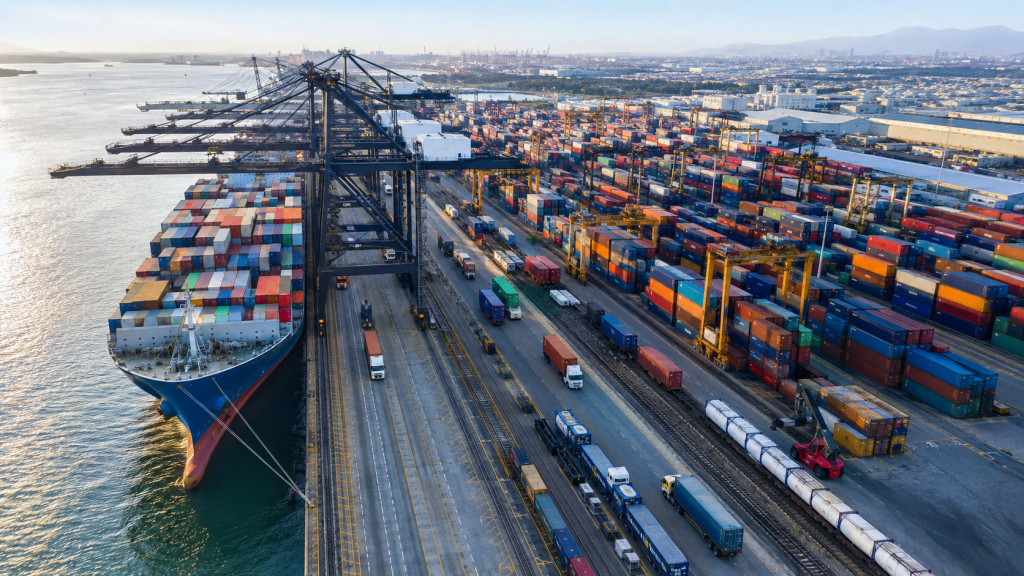
What Happens Inside A Container Terminal?
Every product that reaches a home or a business or a warehouse has travelled through a complex logistics network. Ships crossing oceans often receive the most attention. The real action actually happens inside the container terminal. These are highly organized facilities connecting ocean freight, road transport, rail transport, warehousing & customs operations into one seamless supply chain. Understanding how a terminal works also helps businesses appreciate the importance of choosing the right freight forwarding company for reliable cargo movement.
This guide explains what happens inside a container terminal and why it plays such a critical role in modern global supply chain management.
What Is a Container Terminal?
A container terminal is a specialized facility located within or near a seaport. It serves as the transfer point where shipping containers move between vessels, trucks, rail wagons and/or warehouses.
The terminal acts as the operational hub for ocean freight shipping, enabling cargo to move efficiently across international markets. Every ocean container arriving at the terminal undergoes a series of carefully managed processes before it continues its journey.
Container terminals support:
- Import cargo
- Export cargo
- Transshipment cargo
- Empty container handling
- Customs inspections
- Container storage
- Multimodal transportation
Without these efficient terminals, ocean shipping would face significant delays & very high transportation costs.
Step 1: Vessel Arrival and Berthing
The first stage begins when a cargo vessel reaches the port. Large ocean shipping companies schedule their arrivals weeks in advance. Before docking, the port authority allocates a berth based on vessel size, cargo volume & operational schedules.
Modern terminals use advanced software to coordinate the following:
- Vessel traffic
- Berth allocation
- Crane availability
- Yard planning
- Cargo discharge schedules
Efficient berth management reduces waiting time and improves the overall performance of ocean freight logistics.
Step 2: Container Unloading
Once the vessel is securely berthed, giant cranes begin unloading containers. Each crane can lift containers weighing over 40 tonnes within minutes. Every container is scanned & matched against shipping documents before being transferred to terminal vehicles.
This process supports:
- Sea freight shipping
- Sea cargo services
- International trade compliance
- Secure cargo handling
The objective is to unload thousands of containers quickly while maintaining complete accuracy.
Step 3: Terminal Transportation
After unloading, containers are transported from the quay to the storage yard. Specialized vehicles perform this movement. This internal transportation forms an important part of transit logistics solutions. It ensures smooth cargo movement throughout the terminal. Many advanced terminals also integrate transit point logistics tracking. It allows real-time monitoring of every container's location.
Step 4: Container Yard Management
The container yard is one of the busiest sections of the terminal. Containers are organized according to:
- Destination
- Shipping Line
- Weight
- Cargo type
- Customs status
- Delivery schedule
Efficient yard planning minimizes unnecessary movements & speeds up cargo retrieval. Proper yard management directly supports supply chain logistics by reducing turnaround time and preventing congestion.
Step 5: Customs Clearance
Before imported goods leave the terminal, they must complete customs formalities. This process includes:
- Document Verification
- Cargo Inspection
- Duty Assessment
- Regulatory Compliance
- Risk Assessment
Professional support for customs clearance helps businesses avoid delays and ensures faster cargo release. Experienced ocean freight forwarders coordinate closely with customs authorities to streamline documentation and compliance.
Step 6: Warehousing and Cargo Storage
Not every shipment leaves the port immediately. Some cargo requires temporary storage before onward transportation. This is where warehousing logistics becomes essential. A modern warehouse logistics company provides:
- Secure Storage
- Inventory Management
- Order Consolidation
- Cargo Inspection
- Packaging
Warehousing also improves inventory control and enhances overall supply chain management services.
Many exporters ship smaller cargo volumes instead of full containers. In such cases, warehouses support:
- Cargo Consolidation
- Deconsolidation
- FCL & LCL Shipping
- Cross Stuffing Facility Operations
Less-than-Container Load (LCL) cargo from multiple exporters is combined into one container, while Full Container Load (FCL) cargo occupies an entire container. Cross stuffing facilities are especially useful when cargo changes containers before international shipment. These operations improve container utilization and lower shipping costs.
Step 7: Multimodal Transportation
After customs clearance, cargo continues its journey using different transportation modes. A single shipment may travel through:
- Road Transport
- Rail Transport
This integrated movement is known as multimodal transport or multimodal logistics. Using multiple transportation modes improves delivery efficiency while reducing transit time.
Step 8: Freight Forwarding Coordination
Container terminals work closely with ocean freight forwarders and logistics providers throughout the shipping process. A reliable freight forwarding company in coordinates:
- Vessel Booking
- Documentation
- Customs Clearance
- Cargo Insurance
- Container Scheduling
- Inland Transportation
- Delivery Planning
Comprehensive freight forwarding services in India simplify international trade for exporters and importers.
Step 9: Ocean Freight Tracking
Visibility has become one of the biggest priorities in international logistics. Modern terminals provide real-time ocean freight tracking, enabling businesses to monitor the following:
- Vessel Location
- Container Movement
- Customs Status
- Port Handling
- Delivery Milestones
Special Handling of ISO Tanks
Not every shipment travels in standard containers. Liquid chemicals, food-grade liquids & hazardous materials often move in ISO Tanks.
Container terminals have dedicated infrastructure for the above, in the following ways:
- Safe Handling
- Cleaning
- Inspection
- Storage
- Specialized Loading Equipment
Project Cargo and Heavy Equipment
Container terminals also manage oversized industrial cargo. A specialized project logistics company handles the below & more:
- Heavy Machinery
- Construction Equipment
- Wind Turbine Components
- Industrial Plants
- Infrastructure Materials
These shipments require customized lifting equipment and detailed planning to ensure safe transportation.
Supporting Global Supply Chains
Every activity inside a container terminal contributes to stronger global supply chain management. Efficient terminal operations help businesses to coordinate or manage the following:
- Reduce Transportation Costs
- Improve Inventory Planning
- Increase Delivery Reliability
- Enhance Customer Satisfaction
- Minimize Cargo Delays
First Mile to Last Mile Delivery
A container terminal is only one part of the logistics journey. Modern logistics providers now offer first mile to last mile delivery. It covers every stage from supplier pickup to final customer delivery.
This integrated approach combines or integrates various steps, as follows:
- Inland Trucking
- Ocean Transportation
- Warehousing
- Customs Clearance
- Distribution
- Final Delivery
The result is faster, more reliable cargo movement across domestic and international markets across the globe. Container terminals are far more than places where ships load and unload cargo. They are sophisticated logistics ecosystems that connect ports, warehouses, transport networks, customs authorities & businesses across the world. From ocean freight shipping and air freight operations to multimodal logistics, warehousing logistics, ocean freight tracking & supply chain management services. Every process inside a container terminal is designed to move cargo safely, efficiently, and on time. As global trade continues to grow, efficient container terminals will remain the backbone of ocean shipping. It will enable businesses to strengthen their supply chain logistics, expand into international markets & deliver products to customers with greater speed & reliability.